By Annick F. – Learning Technologist
How can we encourage more student engagement?
It’s a question many of us ask when teaching in Blackboard. Even when learning materials are well prepared, students may still feel disconnected, participate less actively, or struggle to stay motivated outside of face-to-face sessions.
Often, the challenge isn’t the content itself – it’s the learning experience surrounding it.
One helpful way to think about this is through the Community of Inquiry (CoI) model (Garrison, Anderson & Archer, 2000) which brings together three key elements of effective blended/online learning:
- Social presence – Do students feel like they belong here?
- Cognitive presence – Are students encouraged to think deeply?
- Teaching presence – Do expectations feel clear and well supported?
These elements are interconnected. When one is missing, it is usually noticeable in how students engage.
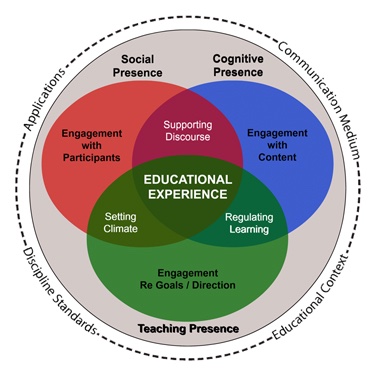
At the University of Derby, these principles are also reflected in our Digital Learning Baselines, which provide clear expectations and practical guidance on how to create effective learning experiences within Blackboard.
Do students feel like they belong? – Social Presence
Students are more likely to engage when they feel part of a learning community, rather than simply accessing content in isolation.
In practice, this does not require complex solutions. A short welcome video, a more personal and approachable tone in announcements, a Week 1 introduction activity, opportunities for discussions and group work supported by digital tools, can make a meaningful difference.
Seeing and hearing their lecturer in an introductory video, and interacting with their peers, help students to develop a sense of belonging on the module and feel more comfortable contributing.
These small adjustments can help shift the experience from something that feels distant to one more human and connected.
The Digital Learning Baselines highlight approaches like welcome videos and collaborative activities as ways to build early connection and encourage participation.
Are students being supported to think deeply? – Cognitive Presence
Engagement deepens when students are actively working with ideas, rather than simply reading or watching content. Cognitive presence supports students in engaging with content, reflecting on ideas, and applying knowledge.
Activities such as discussions, journals, AI conversations, reflective tasks, applied or problem-based exercises that encourage reflection and critical thinking can all support this process.
The way learning is structured is also important. A clear weekly flow, for example, guiding students through preparation (pre-session tasks), study materials, and follow-up activities (post-session tasks), can help them stay focused, build understanding over time and creates a cognitive momentum.
It’s not necessarily about adding more content but about creating opportunities for students to actively engage with their learning.
The Digital Learning Baselines reinforce the value of structured modules, multimedia resources, and asynchronous activities, helping students engage at their own pace while still progressing through the learning content.
Do expectations feel clear and supported? – Teaching Presence
Uncertainty is one of the most common barriers to engagement. When students are unsure what is expected, or where to find things, it can quickly affect both confidence and participation.
A consistent Blackboard structure can make a big difference. Clear organisation, predictable layouts, and well signposted tasks help students navigate the module more easily. When students can quickly find what they need, they can focus their energy on learning rather than navigation.
Regular, purposeful communication is equally important and help keep students informed, engaged and connected. A simple approach, such as a weekly announcement with clear guidance and links, is often effective.
Even small adjustments such as structuring announcements clearly, highlighting key information can enhance clarity and engagement.
In addition, Blackboard tools such as progress tracker, analytics and activity reports provide valuable insight into student engagement allowing tutors to identify students who may need support. Targeted follow-up messages can then help re-engage students and show active support.
The Digital Learning Baselines emphasise the importance of consistent, clear expectations, and regular, purposeful communication, not as an add-on, but as a core part of the learning experience.
Final Thoughts
The Community of Inquiry model can be a helpful way of reflecting on module design.
- Do students feel part of a learning community?
- Are they being encouraged to engage actively with ideas?
- Is the learning experience clear and well supported?
Communication underpins all three elements. It influences how connected students feel, how clearly, they understand expectations, and how supported they are throughout their learning journey.
While Blackboard offers a wide range of tools, their effectiveness depends on how intentionally they are used. Thoughtful design can create a learning environment that feels coherent, structured, and supportive of active participation.
Ultimately, fostering engagement is not about adding more tools, it’s about designing learning experiences that feel human, purposeful, and connected.